Why choose the Camargue for a thalassotherapy break?
Between the Camargue lagoons and the Mediterranean, the Languedoc coast offers a singular setting: neither quite Provence nor quite Languedoc, but a land of lagoons, salt pans and wild beaches where two seaside resorts concentrate the region’s thalassotherapy offering.
This destination ticks several boxes for a wellness break:
- A Mediterranean climate: mild winters and generous sunshine, making treatment stays pleasant all year round
- Two centres open continuously: both establishments welcome guests all year, including off-season
- Genuine accessibility: direct A9 motorway exit, Montpellier airport 30 km away, railway stations nearby
- An immediate hinterland: Aigues-Mortes, Saintes-Maries-de-la-Mer and the Camargue bull farms less than 30 minutes away
- Varied accommodation: from the 4-star hotel within the establishment to inland rentals, with considerable price differences
The 2 thalassotherapy centres on the Languedoc coast
Les Corallines Thalasso & Resort — La Grande-Motte (34)
Set at the Point Zéro, facing the sea, the establishment has been part of the La Grande-Motte landscape for more than 35 years. It combines a thalassotherapy centre with a 4-star hotel of 39 rooms, most with Mediterranean views.
The treatment offering covers the classics of thalassotherapy: hydromassage baths, seaweed wraps, body treatments, facials. Themed programmes are available over 4, 5 or 6 days with 3 treatments daily — fitness, anti-stress, slimming, light legs, or a programme specifically designed for back, neck and shoulder pain.
Facilities include a marine circuit (phlebology walk, swan-neck jets, massage benches, jacuzzi), a heated outdoor pool, a sauna, a hammam, a relaxation room and a fitness area. Two restaurants complete the offering, one with panoramic views.
⚠️ Please note: access to indoor facilities is reserved for guests aged 16 and over, and treatments are not available to minors under 16. Worth checking if you are travelling as a family.
📍 615 allée de la Plage – Le Point Zéro, 34280 La Grande-Motte
Thalazur Port-Camargue — Le Grau-du-Roi (30)
Some twenty kilometres away, across the departmental border, the Thalazur centre occupies a privileged position in Port-Camargue, between dunes and gardens. This establishment likewise combines a thalassotherapy institute, a hotel and a panoramic restaurant on the 6th floor.
The institute covers roughly 300 m² organised into three areas: marine circuit, hydrotherapy and relaxation, complemented by a herbal tea room and a shop. One of the practical advantages most often mentioned by guests: direct access in a bathrobe from the hotel to the institute, the pool and the cardio-fitness room — real comfort when you have several treatments a day.
The offering includes massages, wraps and regularly renewed themed programmes, including more specific support programmes such as one designed for life after cancer.
🕐 Open all year round, daily from 9am to 1pm and from 2pm to 7.45pm (exceptional closures on 1 January, 1 May and 25 December).
📍 227 route des Marines – Port Camargue, 30240 Le Grau-du-Roi
📊 Quick comparison of the 2 centres
| Criterion | Les Corallines | Thalazur Port-Camargue |
|---|---|---|
| Town | La Grande-Motte (34) | Le Grau-du-Roi (30) |
| On-site hotel | 4★ · 39 rooms | Yes |
| Institute size | Full marine circuit | Around 300 m² |
| Bathrobe access | From the hotel | Direct access |
| Outdoor pool | Heated | Yes |
| Sauna & hammam | Yes | Yes |
| Dining | 2 restaurants, 1 panoramic | Panoramic restaurant (6th floor) |
| Minimum age | 16 and over | Restrictions apply |
| Opening | All year | All year · 9am-7.45pm |
| Nearest station | Montpellier (Le Ponant coach line) | Le Grau-du-Roi (5 km) |
Getting there
Both resorts are well served from the main routes. From the A9 motorway, the Gallargues exit leads directly to Le Grau-du-Roi via Aigues-Mortes — the route the establishment itself recommends. La Grande-Motte is best reached via the Montpellier or Lunel exits.
By train, the most convenient station for Port-Camargue is Le Grau-du-Roi, 5 km from the centre; Nîmes is some fifty kilometres away. For La Grande-Motte, the “Le Ponant” coach stop is a 10-minute walk from the centre, on the lines connecting Montpellier, Aigues-Mortes, Le Grau-du-Roi and Nîmes.
Montpellier airport is around thirty kilometres from both resorts.
Where to stay: the 3 options
This is the question that genuinely shapes the budget of a treatment stay. Three approaches are possible, and none is better in absolute terms — it all depends on the length of stay, the number of people and your priorities.
Option 1 — The establishment, all-inclusive
The simplest option, and the one naturally offered by both centres, each with its own hotel. Packages combine accommodation, breakfasts, treatments and access to the facilities.
✅ The advantage: zero logistics. You go down in your bathrobe, move from one treatment to the next, and go back up. For an intensive programme with 3 treatments daily, that comfort genuinely matters — the days are more tiring than you might imagine.
⚠️ The constraint: the price. Weekend packages listed by specialist resellers often fall between €300 and several hundred euros per person for 2 nights, accommodation and breakfasts included. Over a full week, for two people, the bill climbs quickly. It is also the least flexible option: meals and pace are largely set by the establishment.
Option 2 — In the resort, close to the centre
Both resorts offer a range of independent accommodation — hotels, apartments, holiday rentals — a few minutes from the thalassotherapy centre.
✅ The advantage: you keep the proximity while separating treatments from accommodation. You book your treatments à la carte with the centre, and your accommodation separately. This generally reduces the overall bill, especially for groups, and lets you choose freely where and what to eat.
⚠️ The constraint: in peak season, coastal rates rise sharply. Both La Grande-Motte and Le Grau-du-Roi are busy resorts in summer, and prices follow. In July and August, the savings can evaporate.
Option 3 — Inland
A third route, less obvious but often the most economical: stay inland, in the Gard or the Petite Camargue, and drive to the centre each day.
✅ The advantage: inland rates are appreciably lower than on the coast, for equivalent size and comfort. It is easier to find spacious accommodation with a fitted kitchen, terrace and parking — three things that make all the difference over a week-long stay. Being able to have dinner at home after a day of treatments eases the budget as much as the fatigue.
⚠️ The constraint: you need a car and must plan a daily round trip. Allow 20 to 40 minutes’ drive depending on your starting point in the Gard hinterland, meaning around ten journeys over a 6-day programme.
This formula particularly suits group stays, longer programmes, and those wishing to combine thalassotherapy with exploring the region — Aigues-Mortes, Saintes-Maries-de-la-Mer, the Camargue bull farms and the wild beaches of L’Espiguette are all accessible from inland.
📊 Seasonality: when to go to control your budget
This is the most powerful lever. On this coast, the gap between low and peak season can range from single to triple on accommodation. Rather than fixed prices that date quickly, here are the relative levels to know when choosing your period.
| Period | Price level | Crowds | For a treatment stay |
|---|---|---|---|
| January – March | ×1 · lowest | Very low | Ideal |
| April – May | ×1 to ×1.3 | Moderate | Excellent |
| June | ×1.5 | Rising | Good compromise |
| July – August | ×2 to ×3 | Very high | Best avoided |
| September | ×1.5 | Falling | Excellent |
| October – December | ×1 to ×1.2 | Low | Ideal |
Relative indices observed on holiday rentals along the Gard and Hérault coast. Absolute levels vary according to accommodation type, capacity and booking lead time.
💡 The smart move: since both centres stay open all year, there is no need to come in summer. May, June, September and October combine pleasant weather, quieter centres and accommodation half the price of August.
💰 How a treatment stay budget breaks down
It is difficult to give reliable, lasting prices: rates vary with the season, the length of stay, the number of treatments and when you book. Better to think in terms of cost categories.
- Treatments: the fixed element, booked directly with the centre
- Accommodation: the most variable element — and therefore the one you can genuinely act on
- Meals: greatly reduced if your accommodation has a fitted kitchen
- Travel: negligible if you stay on site, to be factored in if you come from inland
- Tourist tax: in Le Grau-du-Roi, it ranges from €0.90 to €4.73 per person per day depending on the accommodation’s official rating. For unrated furnished rentals, it is calculated as a percentage of the nightly rate
It is by acting on accommodation and meals that you make the real difference — not by economising on treatments, which are the very reason for the stay.
How to choose: the key markers
For a weekend or a short stay for two, the establishment’s all-inclusive package makes sense: simplicity outweighs savings when the stay is brief.
For a week-long programme, separating treatments from accommodation becomes markedly more attractive financially — the price difference compounds over 6 or 7 nights.
Off-season, the gap between coast and hinterland narrows: staying in the resort becomes competitive again, and it is the best period for a treatment stay.
In peak summer season, conversely, inland regains its full advantage, both on price and on peace and quiet.
🗺️ What to do between treatments: the region’s highlights
A treatment programme generally takes up the mornings. That leaves the afternoons — and on this coast, there is enough to fill an entire week without ever getting back on the motorway. Here are the sites not to miss, all within 30 minutes of both centres.
Aigues-Mortes, the medieval city of the sands
Just 6 km from Le Grau-du-Roi, Aigues-Mortes is the essential excursion. A fortress of pale stone set among the lagoons and salt marshes, whose ramparts form a perfect 1.6 km quadrilateral that has remained almost intact since the Middle Ages. It was here that Saint Louis had the Kingdom of France’s first Mediterranean port built in the 13th century.
Walking the full circuit of the ramparts offers a unique panorama over the salt pans and the Camargue. The Tower of Constance, where the king stayed, can also be visited. The streets within the walls are lively with artists’ and craftspeople’s workshops.
💡 Practical tips: visit the ramparts early in the morning for the cool air, or late in the day to see the stone glow at sunset. In summer, a hat is strongly recommended. For parking, favour the car parks along the canal, less crowded than those in front of the Porte de la Gardette. From Le Grau-du-Roi, you can also reach the city by train from the station, or by bike in 20 minutes along the ViaRhôna, which follows the maritime channel for 6 km.
🥐 Worth tasting: the fougasse d’Aigues-Mortes — nothing like the savoury fougasse found elsewhere. Here it is a soft sweet brioche flavoured with orange blossom, the official holiday snack of the Camargue. Available in all good bakeries within the walls.
The Salins du Midi salt pans
Right next to Aigues-Mortes, the salt pans extend over an area equivalent to around 10,000 rugby pitches. The salt tables take on spectacular pink hues depending on the light and season. Tours are organised by tourist train, by bike or on foot, and explain the production of fleur de sel, an ancestral activity still very much alive.
L’Espiguette point and lighthouse
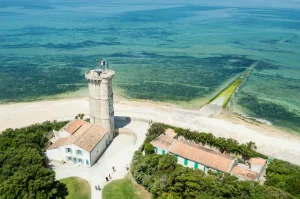
At Le Grau-du-Roi, L’Espiguette is one of the last great wild beaches on the Mediterranean coast: a vast desert of dunes, free of buildings, where you can walk for a long time without meeting anyone off-season. The lighthouse makes an excellent walking objective, between sea, dunes and lagoons.
For a more accessible, family-friendly beach, Le Boucanet offers a more conventional seaside atmosphere, with facilities nearby.
Le Grau-du-Roi village and Port-Camargue
The old village has kept its fishing-port character: boats moored along the quays, preserved facades, a daily fish auction, and a canal cutting through the historic quarter lined with terraces. The palm-lined avenue, the Villa du Dauphin and the lighthouse complete the walk.
Next door, Port-Camargue is Europe’s largest marina, designed by Jean Balladur — the architect of La Grande-Motte — and listed as 20th-century heritage since 2015. Its Florida-inspired marinas are worth the detour for their architectural originality alone.
The Camargue’s nature and flamingos
The Camargue gardoise is classified a Grand Site de France. Saltwater lagoons, marshes, freshwater ponds: a vast wetland of biodiversity recognised as of European interest. The Scamandre Nature Reserve and the Grand Site house at La Marette (discovery trail, ecomuseum, exhibitions) offer accessible immersion.
To see flamingos, the Pont de Gau ornithological park offers the easiest approach. Binoculars recommended, and observation distances must be respected.
Saintes-Maries-de-la-Mer and Camargue culture
The capital of the Camargue, Saintes-Maries-de-la-Mer offers full immersion in the local atmosphere: fortified church, gypsy pilgrimage, wild beaches. Along the way, the manades — Camargue bull and horse farms — offer visits and horse rides.
On the traditions side, the Le Grau-du-Roi arenas host Camargue races and shows depending on the season. Check the programme before setting off.
🌙 Evenings: beach clubs and nightlife
La Grande-Motte is known for its paillotes — beach clubs that turn into lounge bars after dark. You dine with your feet in the sand, then the atmosphere builds as the evening goes on.
Among the emblematic addresses, La Paillote Bambou, on the Couchant beach, has welcomed visitors since 1996 in a setting of driftwood and white design furniture. Open from April to September, it offers sun loungers and lounge beds during the day, then from 8pm its cocktail area comes alive to electro sounds. Another local institution, La Voile Bleue, open since 1997, whose parties are famous as far as Montpellier.
To carry on into the night, La Dune remains the resort’s reference club, a few minutes’ walk from the private beaches.
💡 Good to know: the beach clubs operate mainly from April to September. Off-season, evening life shifts to the port restaurants and the quays of Le Grau-du-Roi — quieter but more authentic. Book ahead in peak season, especially for dinner.
⚠️ A word of caution: after a day of treatments, tiredness comes on faster than you might expect, all the more so in the heat. If you are driving back inland, keep alcohol consumption moderate.
Day trips
If you are staying a week, several major sites are within driving distance — enough to turn a treatment stay into a genuine discovery holiday.
Less than an hour away:
- Montpellier (30 km): historic centre, Place de la Comédie, Musée Fabre, Planet Ocean aquarium
- Nîmes (50 km): Roman arena among the best preserved in the world, Maison Carrée, Carré d’Art
- Beaucaire Castle (55 km): medieval fortress overlooking the Rhône, with falconry displays in season
- Arles (60 km): ancient arena, UNESCO-listed Roman heritage, Camargue Museum
- The Pont du Gard (60 km): UNESCO World Heritage Roman aqueduct, with swimming possible in the Gardon
- Le Grau-du-Roi Seaquarium: on site, ideal with children or in cloudy weather
One to one and a half hours away:
- Avignon (95 km): the Palais des Papes, the world’s largest Gothic palace, and the famous Saint-Bénézet bridge
- The Roman theatre of Orange (110 km): a stage wall unique in Europe, UNESCO-listed
- Grotte des Demoiselles (80 km, Hérault): an underground cathedral of spectacular formations, reached by funicular
- Pic Saint-Loup (60 km, Hérault): the emblematic silhouette of the Languedoc, panoramic hiking and renowned vineyards
- Cirque de Navacelles (110 km, Hérault): a Grand Site de France, a fossil meander carved by the Vis, one of the most spectacular landscapes in Occitanie
💡 The smart move: if you stay inland, you are already halfway to most of these sites — the Pont du Gard, Nîmes, Avignon and Pic Saint-Loup all come noticeably closer. An argument often overlooked when choosing accommodation.
Planning a treatment stay on the Languedoc coast? Browse the accommodation available near the thalassotherapy centres on SejourThalasso.fr, bookable directly, with no intermediary.